




How CNCs Are Responding to Customer Demands For Ease-Of-Use, Cost Reduction and Predictive Maintenance
Machining is a team sport. Customers might be the quarterback, directing operations, but HEIDENHAIN is at their side, with their CNC controls helping throughout the machining process: from initial part design to final finishing, from single-part to serial production, and from simple slots to complex contours.
Just as a team listens to their quarterback, they listen to their customers. HEIDENHAIN listens to their requirements, their wishes for CNCs and the trends they see going on around them.
Two of the most important current trends in CNCs that their customers talk about are:
- User-friendly interface and easy programming: CNCs have become more intuitive and easier to use, helping younger operators that may not be as skilled as more experienced ones.
- Predictive maintenance and component monitoring: new machine tools are IoT-ready, and the CNC interacts with software and IT systems to enable condition monitoring of the machine and predict when some components need replacement/maintenance, to avoid downtime and to keep the machines and the facilities as productive as possible.
This article will explore how the HEIDENHAIN TNC7 contouring control addresses these trends. They’ll also discuss how they relate to the trend they’re seeing for nearshoring or reshoring manufacturing to bring it back home. This raises two specific challenges for the industry: firstly, a shortage of skilled labor, and secondly, the need to have a competitive advantage (over both domestic and international competitors) with efficient and reliable processes.
More generally, beyond these two trends, it almost goes without saying that energy consumption and cost reduction, in general, are always important issues that underlie all trends. The TNC7 contouring control addresses this by optimizing the machining process in order to reduce energy consumption, scraps, and cycle times. For example, by achieving the highest levels of precision, the TNC7 minimizes defects and scrap, thus reducing both production time and cost.
Attracting workers with a user-friendly interface
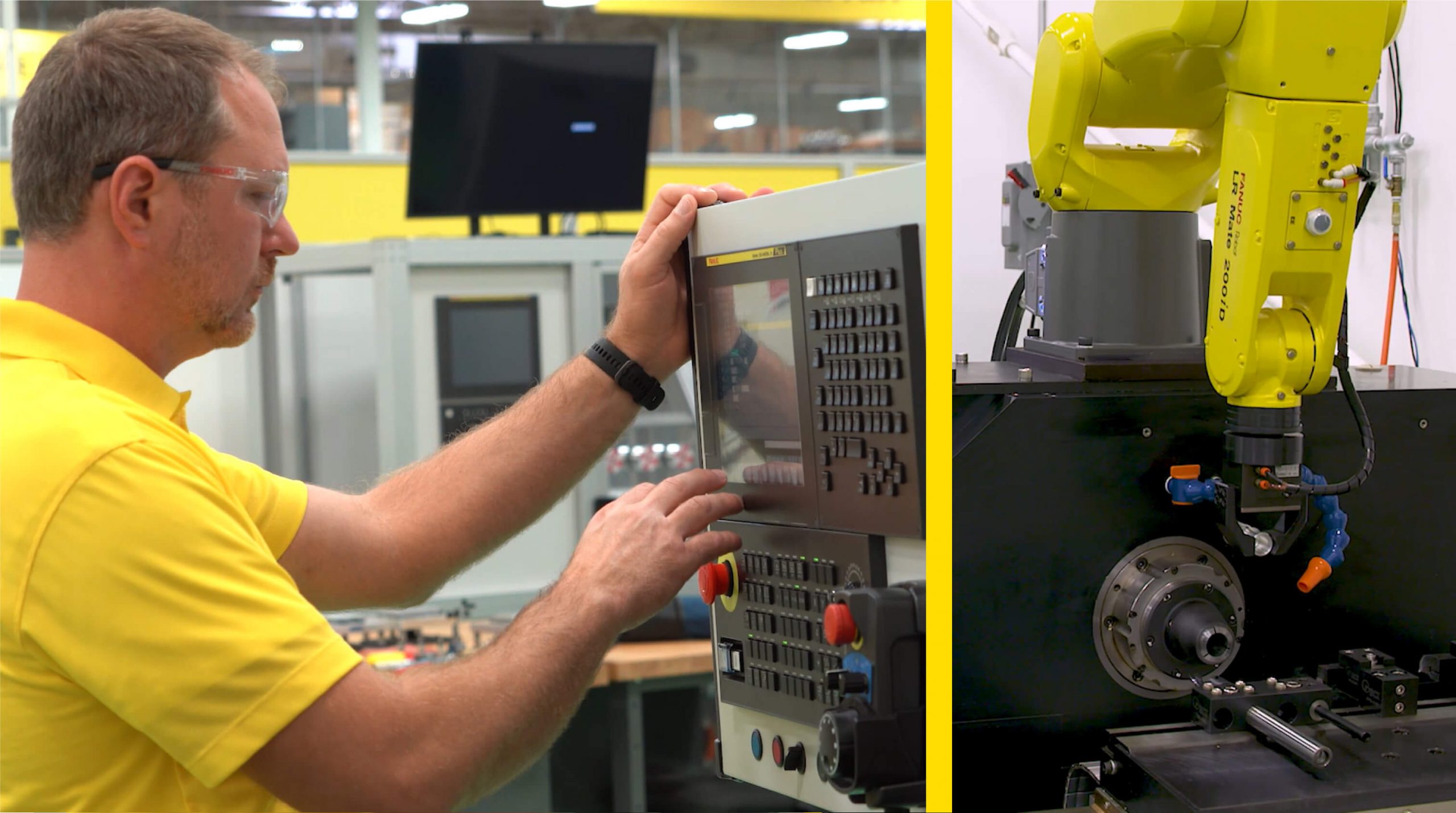
Looking at the labor shortage first, HEIDENHAIN has made big steps to overcome this for their customers by completely changing the approach to a control’s user interface. If you look at a conventional CNC control today, you will find a lot of buttons, and if you don’t use those buttons, the machine will not work.
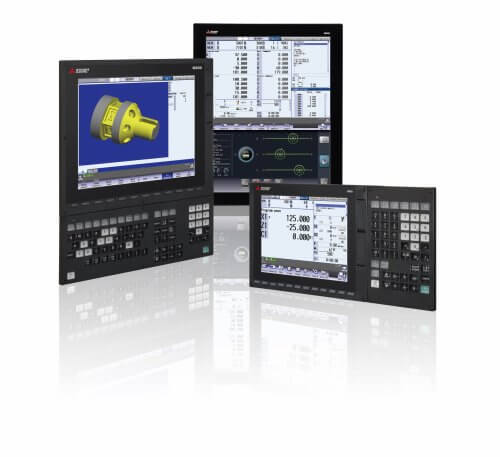
Instead, they said let’s make the control more user-friendly, based on what’s familiar to the next generation of operators. So, they got rid of the buttons, and they have a big, 24-inch touchscreen now. HEIDENHAIN allows the operator to customize the look and feel of the control so they can operate the machine the way they like. This helps the shop owner to attract younger people into the shop because they want to operate a machine tool with that technology.
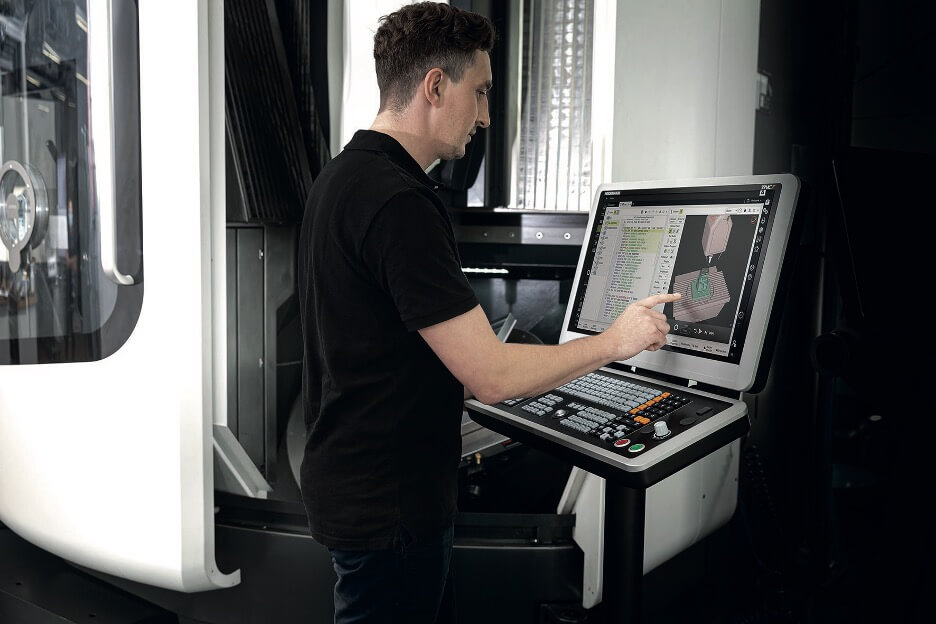
Users of the TNC7 benefit from a customizable screen and smooth, intuitive touch operation.
They’ve also made programming simpler where possible. For example, the DCM (Dynamic Collision Monitoring) and OCM (Optimized Contour Milling) functions of the TNC7 help make the milling process easier, thus reducing programming from the operator.
Does it matter? Yes, it does. They just came back from IMTS, one of the biggest machine tool events in North America. One thing they saw there is lots of interest from high school students and young adults – 14,000 students came to the Manufacturing Student Summit area this year to learn about what’s new in manufacturing. It’s encouraging that they have these young generations coming into the manufacturing space again, and they can take advantage of these new, engaging technologies that get them excited about 3D graphics on the screen.
HEIDENHAIN thinks this user-friendly interface of the TNC7 is a breakthrough. None of their competitors have a similar interface, but we’re expecting to see imitations being developed at some point.
Competitive advantage through efficient, reliable processes
The other important area for their customers is to be more efficient and competitive, and to have a reliable process. When they put their workpiece into the five-axis machine, they want to machine the part only once, and then when they take it out of the machine it’s perfect. They cannot afford to do rework, re-clamp the part, or bring it out of the machine, inspect it and bring it back to the machine for additional work.
Within the TNC7 control, they can monitor the entire process. They can look at whether the part is within specifications or not. They can also help the operator to set up the part safely with DCM in the machine, so there is no collision and damage to the part or the machine. That helps new operators, but it also helps operators who are coming from a three-axis machine tool to a five-axis machine tool feel safer.
This is all within the TNC7 control, but when you look beyond that, HEIDENHAIN has a whole range of other components developed for process reliability. For example, the TD 110 is an inductive tool check system, which makes sure that the tool is not broken before it goes to the next process. You can just quickly check within a couple of seconds if the tool is broken or not. If it’s not, you continue the manufacturing process, with minimum time wasted.
Another new product is the VT122. This product inspects a cutting tool from top to bottom with microscopic accuracy. So, when the machine uses a cutting tool, it knows the exact size, diameter and quality of that tool before starting the machining process.
Putting this all together, shops have a really reliable process from start to finish, starting with the TNC control. It’s safe to program and set up the machine, and with component and process monitoring, it communicates back to the control and completes a closed loop for process reliability.
This component monitoring enables predictive maintenance, where failing components can be identified and replaced before they bring machining to a halt – thus eliminating unplanned downtime. They can also both internally record the data generated and externally transmit that data through an ERP or an MES system, through their state monitor monitoring software.
In fact, HEIDENHAIN is the only supplier that makes all the relevant motion control components, including the control, motors, drives, angle encoders, rotary encoders and communication between those components back to the control. This enables a closed system, which means that components can communicate without latencies and the need to slow down the process to get data. Thus, HEIDENHAIN can improve process reliability and process speed, so they can machine a part faster and to a better quality.
Conclusions
In the United States and worldwide, a lot of companies are shifting from three-axis applications to five-axis applications. There is also a higher demand for precision and efficiency because the semiconductor market is growing, which demands sophisticated manufacturing processes with very high accuracy and repeatability.
To meet these growing demands is a tough ask. At the same time, their customers need to cope with labor shortages and the need for excellent reliability.
With the TNC7, they believe they deliver a high-end solution for CNC manufacturing, that is also easy to use and integrates with other HEIDENHAIN products to deliver a reliable, optimized system.
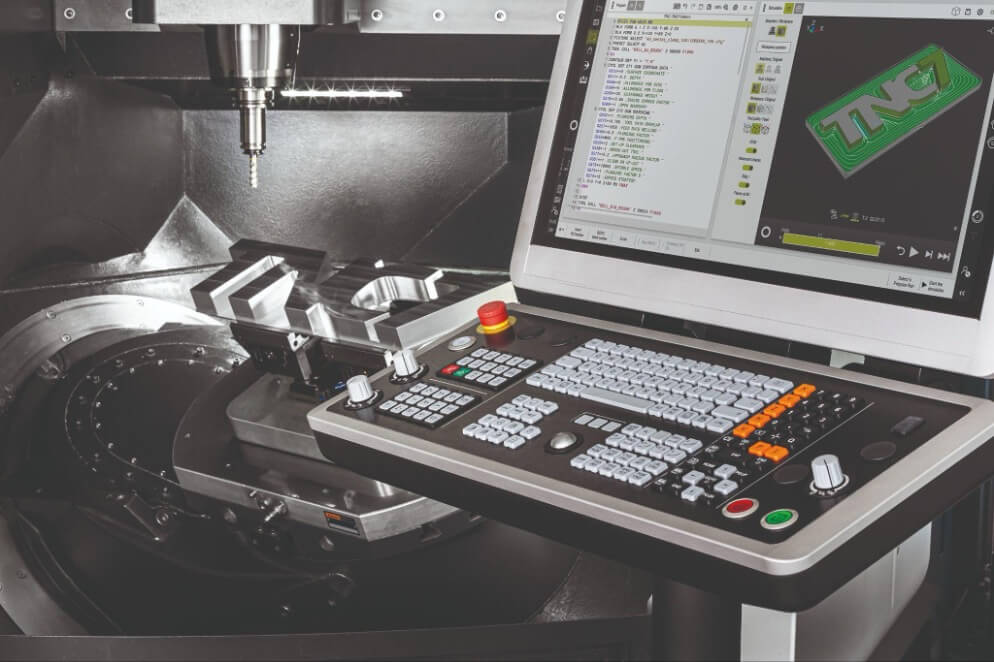
TNC7: the new level in CNC control.
As the customer, you’re still the quarterback – but the TNC7 and their team of supporting players are right there in the action with you.