





Introduction to Dead Centers
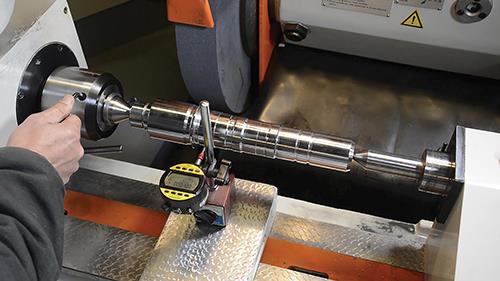
Dead centers are tools used to hold a workpiece in place between the head and tailstock, often times in a lathe application, but also in other machine tool applications. Centers can be overlooked, but they play a crucial role in the accuracy of the operation and thus the part produced.
Dead centers are similar to live centers in that they require drilled holes at the end of the workpiece to hold it in place. Unlike live centers, however, dead centers are not equipped with bearings and therefore do not turn with the workpiece, unless they are inserted in the spindle nose. If you’re interested in learning more about live centers and how they work, check out Introduction to Live Centers.
You can also join the conversation on the Practical Machinist forum where members are discussing the difference between live and dead centers.
Anatomy and Types of Dead Centers
Although the anatomy of a dead center is quite simple, there are some features to break down. The point at the tip of the center comes in many different sizes.
Some of the different types of point tips are:
- Standard points – used for the most common applications
- Bull nose points – support heavy loads and hostile work environments
- Long points – allow for better tool clearance
- Pipe points – great for applications with thin-walled pieces like tubing or piping
The different points will work in different ways, so make sure you know which kind your application requires.
Some other features that influence the performance and dead center type are qualities like carbide tips and high-speed engagement For example, if your project requires speeds of more than 6,000 RPM, you will want a high-speed dead center. If you want the center to last for a while, make sure to invest in a carbide tipped dead center as they support longevity.
There are two commonly used types of dead centers. The standard dead center and half dead center are similar in function, but differ in that the half dead center has half of the conical shaped point. The image below showcases that anatomical difference.
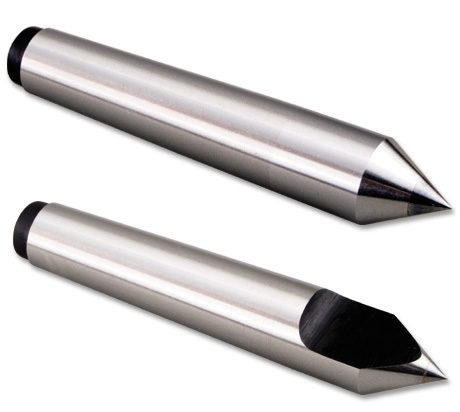
Half dead centers are used for projects where the workpiece is smaller than the dead center itself. The portion that is cut away allows clearance, whereas with the standard dead center clearance wouldn’t be achieved.
Recommended Dead Center Models
MT3 HIGH Precision Carbide CNC Threaded Lathe Dead Center Morse Taper
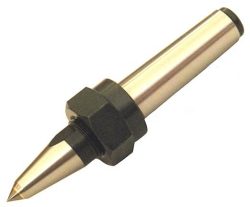
MT3 HIGH Precision Carbide CNC Threaded Lathe Dead Center Morse Taper

Designed for CNC lathes, this alloy tool steel dead center has been heat treated for high rigidity and high abrasion resistance and features a carbide tipped center point. A removable nut is also included in the package.
Omex Lathe Dead Center MT2


OMEX LATHE DEAD CENTER MT2 – ALLOY STEEL HARD & GROUND CENTER 2MT

This Omex lathe dead center is made of alloy steel that has been hardened and ground. This dead center is mainly used for classic lathe operations but can also be used for drilling. It is recommended that you use lubrication with this particular dead center.
MT3 Carbide Lathe Dead Center Morse Taper
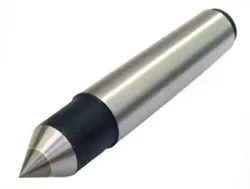
MT3 Carbide Lathe Dead Center Morse Taper 3 Z Live Center 03016A

This high-quality dead center features a center point that has been tipped with hard carbide to enhance abrasion resistance and is made of heat-treated alloy steel. This model is offered from Morse Taper 2 to Morse Taper 6.
Atoplee 60 Degree Point Morse Taper
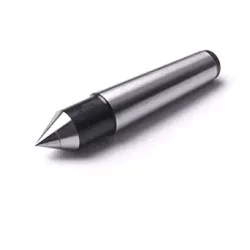
ATOPLEE Morse Taper Dead Center

The top point of this dead center is made from carbide while the handle is made from #45 steel. This dead center is mainly suited for grinding machines, milling machines, lathes, and drilling machines and the center hole positioning makes for very high precision.
TTC 4 MT Carbide Tipped Dead Center
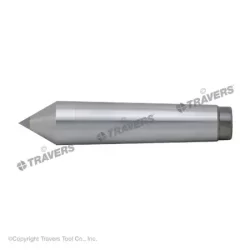
TTC 57304MT 4MT Carbide Tipped Dead Center

This dead center is great for precision applications and is made from hardened and ground tool steel. Featuring a carbide tip, this dead center can be used many times and promotes resistance to wear.
Steelex M1072 MT No.4 Bull Nose Center
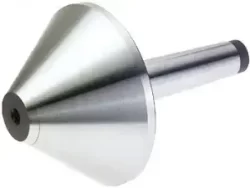
Steelex M1072 MT No.4 Bull Nose Center

This bull nose dead center was constructed for large and hollow workpieces like pipes, tubing and other material that would swallow a regular live center. Designed particularly for heavy-duty use, these centers are also sealed, thus resistant to dust.
This post may contain affiliate links. Please read our disclosure for more info.

9 Comments
You forgot to talk about the lube. I haven’t used a dead center in the tail stock for eons but we used to use white lead,,,,which is now illegal. What do people use today?
Yes, I would like to know the answer that Mathew Molk asked ??
111 is a product specifically designed to replace white lead, it mixes well with light oils and can be used as
a lubricant coolant for thread cutting, reaming, tapping and drilling. I am sure there are others but this one that came to mind first
We use way oil. works great.
Good point! (No pun intended) I have used a couple of drops of cutting oil or WD-40. Both worked ok.
We always used tallow as a lubricant on dead centres.
Who the heck wrote this? As a job shop machinist, this is not stuff that is for a forum that is 99% CNC/production related
I useCMD Extreme Pressure Lube #3 when using a dead center in the tailstock
Molyslip or Copper Coat do an equally go a job as White Lead. Or some machine oil, but not quite as good. This later needs regular application, which can be done whilst machining. The secret to the use of any of them is to have the dead centre in contact but with a very light load. Recall that the dead centre should be used in such circumstance for accurate finishing. To ensure all cylindrical surfaces on a shaft (think gear shaft by way of example) are concentric. Roughing is done with stronger holding methods e.g. 4 jaw independent chuck.
The stock removal should be 1mm or less on the diameter. Then all will work nicely.