





Stop the Chatter
SPONSORED CONTENT
Good Vibrations? To a machinist, there’s no such thing
Deep boring operations on a CNC lathe are often problematic. Adequate coolant flow can be difficult to achieve, making tool life unpredictable. Chip evacuation is similarly challenging, especially on blind holes, which on a lathe or multitasking machine is usually the norm. But it’s the tool deflection and resultant chatter that’s the biggest thorn in any machinist’s side, something they’ll take significant measures to avoid.
Home-grown solutions
For instance, mounting the boring bar in a lead sleeve was once a common way to break up chatter, at least until people discovered the dangers of lead poisoning. Machinists have since moved on to sleeves made of brass or aluminum, but these homemade chatter remedies are only minimally effective.
Other stop-gap remedies include tipping the bar slightly above or below center or playing with the feeds, speeds, and depths of cut until discovering the “Goldilocks” zone at which chatter is minimized. But assuming this elusive balance can be found, the problem then becomes one of poor chip control, short tool life, and less than desirable surface finish.
Carbide shank bars have long been the go-to solution for deep hole boring, although these are limited to length-to-diameter ratios of around 6:1, depending on the application, and are generally unavailable beyond 1-inch (25.4 mm) in diameter. For shops turning oil field parts, aircraft landing gear, or any parts with large, deep bores, the options are limited.
Better boring
The good news is that several cutting tool manufacturers have developed high-tech boring systems to address this problem. These contain an internal mechanism that suppresses vibration, stopping chatter in its tracks. The result is trouble-free boring up to 10xD, with improved tool life, better part quality, and none of the feed and speed limitations so many machinists are familiar with.
Kennametal, for example, recently released a new and improved version of its tunable boring bar, first patented in 1982. Perhaps the biggest difference between the new system and the old is that there’s no longer any need to tune the bar for different cutting conditions—thanks to a robust internal damping package, operators can just set it to the desired length, put the tip on center, and get to work.
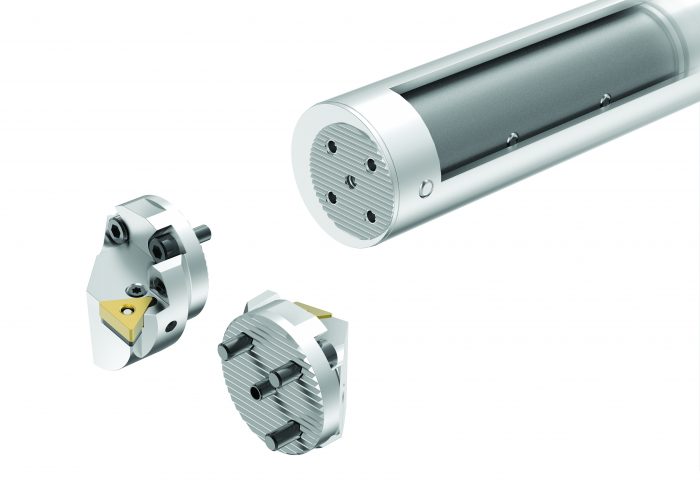
Modular boring systems should be vibration-free, easy to use, and require little in the way of adjustments. Access to an assortment of boring heads reduces setup time and minimizes investment costs
A boring system like this offers many benefits aside from being vibration free (although chatter elimination is clearly its chief advantage). As already mentioned, length-to-diameter ratios of 10:1 are possible, outperforming steel and even carbide shank tools by a sizable margin. And because there’s no more worry about chatter, programmers and machinists are free to optimize their cutting parameters for maximum productivity, tool life, part quality, or all of the above.
Freedom to take heavier cuts or feed faster also solves the problem of chip control, and when chips are broken up into manageable lengths, they’re much easier to flush out of the hole. The vibration-free bar’s through-the-tool coolant capability and precision-placed orifice also helps, especially when used with a high-pressure coolant pump. No more chip jams, no more scrapped parts.
The nuts and bolts
A modular boring system is also more flexible compared to brazed and indexable bars. Point in case, Kennametal’s serrated, bolt-on coupling is not only extremely secure, but it accepts heads for 80-degree diamonds, Trigons, triangular-shaped and profiling inserts, and more (even back-boring).
Like the bar itself, the heads have also been redesigned for reduced weight and shorter length, further enhancing the anti-vibration effect while increasing stability and repeatability. But if your shop is already using one of Kennametal’s bars, don’t worry—your legacy heads will fit with an adaptor.
Whether using Kennametal’s boring system or someone else’s, however, it’s important to follow some boring bar best practices. In order to maximize rigidity, always use a split sleeve rather than a pair of set screws, which is why Kennametal has partnered with machine tool builders such as Okuma, Mazak, and others to offer machine-specific split blocks for boring.
Right on center
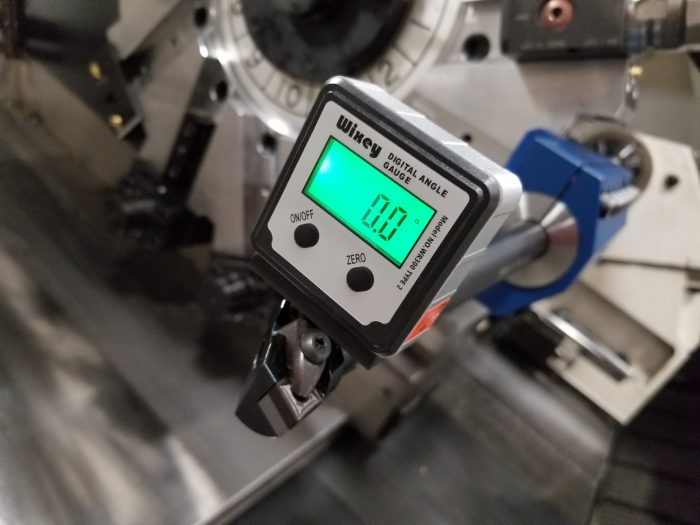
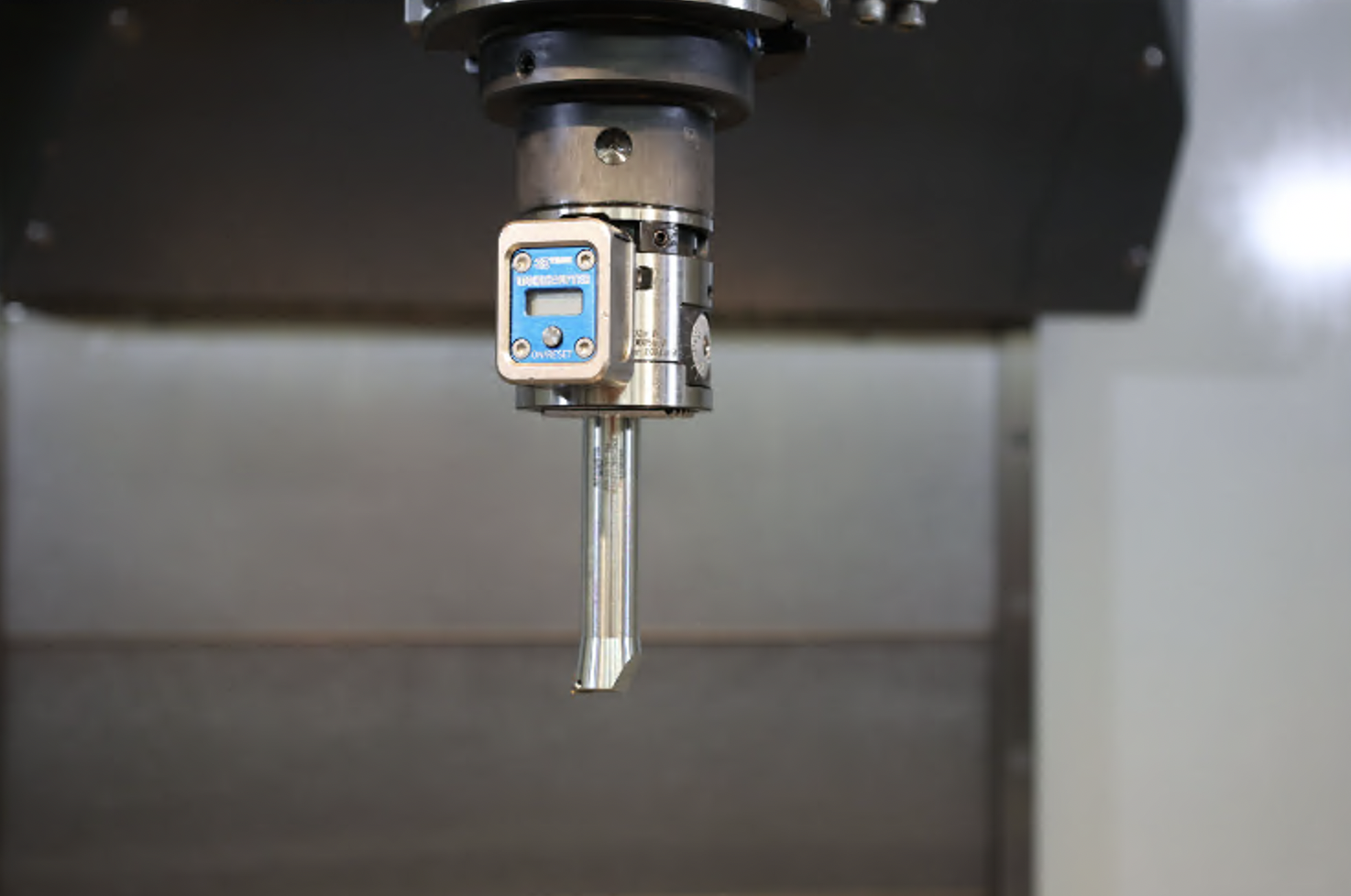
Achieving the exact centerline with a boring bar can be challenging without a digital angle gage such as the one shown here
As any machinist knows, getting the bar on center is also important, although this is sometimes difficult to achieve. Kennametal’s made it a little easier by placing a reference flat on the top of the vibration-free bar—by setting a Wixey (or equivalent) digital angle gauge on this flat, it’s easy to get the cutting tip exactly where it needs to be. Forget about bluing up the end of the part and scribing a mark with the tool tip.
Another consideration is length. Unlike a carbide or steel shank boring bar, anti-vibration bars contain complex mechanisms. Shorten one too much and you might receive an unpleasant surprise when the liquid within leaks all over the floor. Be sure to follow the manufacturer’s recommendations when modifying one of these bars, or buy a shorter version if needed. Finally, look for a system that offers plenty of size options as well—Kennametal’s go up to 4-inches in diameter (100 mm) and 54-inches in length (1410 mm).
One final word on the investment: anti-vibration boring bars aren’t inexpensive. You can figure on spending roughly two or three times what you would for a conventional boring bar. But don’t let a case of sticker shock scare you away from a solution that can easily pay for itself within months. Less downtime, lower perishable tooling costs, greater throughput, and chatter-free surface finishes—these are just a few of the benefits of a high-tech boring system. Why settle for anything less?
LEARN MORE ABOUT THE VIBRATION-FREE BORING BARS
Author: Nick Gaten, Director of Global Product Management for Turning Products at Kennametal Inc., Latrobe, Pennsylvania

5 Comments
You also should always use the correct chuck when milling or druilling to avoid chattering. Since a HPC collet chuck also avoids chattering onto a certain grade, since the collet has a dampening function, where a Weldon or other holder would be too stiff !
Plasticine is also a Good dampener to vibration, I have removed a half-inch from the top of a 1/16 dia punch feeding into the side of a grinding wheel by packing plasticine around the punch, that was on a Jones and Shipman 540 toolroom, I have also used it on the lathe when boring,
Haas has a sub program that raises and lowers the rpm of the spindle. m138 I believe is the code. I have seen hardened 15-5 ss turned to .5 ” dia and 12″ long and hold +/- .002″ in dia. If your cnc lathe has this sub program routine available , give it a try, You will be impressed.
You are 100% right. The right holder makes all the difference for boring too. Recently, our customer purchased a new machine and was experiencing chatter issues when cutting box threads on 12″ pipe for an oil-field application. They were using bars with mass dampers but still experienced chatter while threading. Switching them over to a split tool block instead of a set screw tool block solved the problems. The split block works by using clamping bolts to close completely around the shank of the boring bar using bolts through the holder. This provides the bar with zero pivot points and creates a very solid connection. A typical set screw block holds a bar at two or three points (set screws) on one side and only makes contact along a line opposite of these set screws. The set screw block also has to be made oversize for sliding clearance. There is nothing wrong with set screw blocks for your typical processes but you should always use a split block for mass dampened tooling.
M38 is the code to start variable spindle speed and M39 is the code to stop it. Settings 165 and 166 determine the amount the spindle speed changes and how fast it happens. Be careful not to let the top-end SFM “clip” because your G50 is set too low (ex: G97 s600 with 200sfm variance should have a G50 of at least s800, G96 can get even more tricky, so watch out for that, too). This should also *not* be used as your go-to method for eliminating chatter, it’s more of a last resort for not-ideal but unavoidable setups that compromise rigidity. Before you use M38 you should check that your tool is rigid, centered, and the offsets properly dialed in. You should also make sure there isn’t a better, more rigid work-holding setup, like deeper jaws with curves that match the diameter of your work-piece and clamp tightly around it for a better bite. Lastly, dial in your feeds and speeds to optimize chatter reduction. After you’ve done all that, then, and only then, should you resort to M38. You don’t want to spend your whole shift adjusting settings 165 and 166 just to find out a set screw was loose or your tool was off-center or something.
Haas has a short, but great little video on it if you’re pulling your hair out because 1st shift crashed your machine and now it’s running like hot garbage, chattering all over the place no matter what you do. Also, clear it with your supervisor first,. I got in trouble for using M38 even though the parts were running better because nobody else knew what it was and the spindle speeding up and slowing down like that made a scary sound they didn’t like.